‘Korperkultur: The Culture of the Body in Germany and the USSR from the 1910s to the 1930s'
Until Feb. 25 at Art Deco Gallery, 2/4 Luzhnetskaya Nab., bldg. 4 (Art Plaza business center, 2nd floor), m. Vorobyovy Gory, www.artdecogallery.ru
Open weekdays 11 am-8 pm
As part of Germany's Year in Russia, “K?rperkultur” explores how artists in both countries represented the human body during the first decades of the 20th century.
“Both in Germany and Russia, this period was characterized by a more open look at the human body and the discarding of classical standards,” curator Raul Agrba told The Moscow News.
In the early 20th century, Germany witnessed an explosion of interest in the human body. Books and brochures on the beauty of the body and its improvement enjoyed wide-spread popularity, thanks in large part to their nude photos of dancing and exercising women and men. As gymnasts and dancers experimented with new forms, photographers and painters explored fresh ways of capturing body movement.
Nikolai Zagrekov, ‘Gerta Attacks,' 1930 (The Russian Museum)
In Germany, modern dance pioneer Rudolf Laban developed the concept of “free dance,” which demanded that dancers reject memorized movements and music, and instead develop their own artistic language. Despite significant ideological differences with Germany, similar experiments were conducted in the Soviet Union, where the idea of “new dance” originated at the “choreological” laboratory of the Russian Academy of Artistic Sciences in the '20s. Among the laboratory's founders were several well-known artists, including Vasily Kandinsky and Alexander Larionov.
The exhibition's primary focus is on German sculptor Ferdinand Preiss and Russian-born painter Nikolai Zagrekov. The latter studied under renowned artists Ivan Mashkov and Pyotr Konchalovsky before moving permanently to Berlin in the early '20s. The Preiss sculptures are being exhibited publicly for the first time.
The German sculptor's works, particularly the “Ecstasy” series, serve as vivid illustrations of Laban's “free dance” concept. Zagrekov's work also reflects the artist's interest in human body, with paintings such as “Spear Thrower” featuring people working or playing sports.
Viewers can compare sculptures and paintings with period photos from German magazines and books. The exhibition also includes photos illustrating director Vsevolod Meyerhold's theory of “biomechanics,” a highly physical style of performance that drew on mime and commedia dell'arte.
Art Hit gallery of original paintings for sale. Original paintings galleries: Abstract art. Surrealism. Impressionism. Original paintings for sale. Fantasy art gallery. Original oil painting, drawing, sculpture art


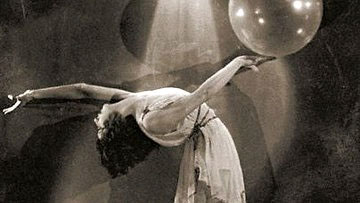 In the early 20th century, Germany witnessed an explosion of interest in the human body. Books and brochures on the beauty of the body and its improvement enjoyed wide-spread popularity, thanks in large part to their nude photos of dancing and exercising women and men. As gymnasts and dancers experimented with new forms, photographers and painters explored fresh ways of capturing body movement.
 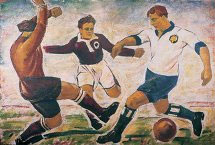 The exhibition's primary focus is on German sculptor Ferdinand Preiss and Russian-born painter Nikolai Zagrekov. The latter studied under renowned artists Ivan Mashkov and Pyotr Konchalovsky before moving permanently to Berlin in the early '20s. The Preiss sculptures are being exhibited publicly for the first time.


